NIOB | Der Mikrokosmos | 2017 | Bimetallmünze


69,00 €
plus shipping costs
Activate price radar
Let us notify you when the product price is within a range that is of interest to you.
Price radar active at
Price radar active at
„NIOB | Der Mikrokosmos | 2017 | Bimetallmünze“ zum Verkauf gemerkt.
Zum Ankaufsformular
The 2017 niobium coin shows the history of exploring the microcosm
Even in ancient times, magnifying glasses were used in the search for the secret of life. In the 17th century, the Dutch naturalist Antoni van Leeuwenhoek produced microscopes that achieved up to 270 times magnification. He used them to examine pond water, saliva and dental plaque and discovered tiny "little animals", which we now call bacteria.
In the 1930s, the German engineer Ernst Ruska invented a microscope in which he used an electron beam instead of visible light; this enabled him to achieve a magnification of 12,000 times. The electron microscope became an indispensable tool in physics, chemistry, biology and technology; it could even be used to image individual molecules and atoms. The scanning tunneling microscope brought a further leap forward in 1982; it does not "see" surface atoms, but "feels" them. With this important instrument of nanoresearch, a key technology of the 21st century, individual atoms and molecules can be touched and moved.
The obverse: The coin shows a butterfly with outstretched wings in raspberry-red and grass-green niobium. Above it is an atomic symbol. On the left, parts of a molecular chain can be seen extending from the silver ring into the niobium part of the coin. The motifs in the silver ring show enlarged details of the main motif. Starting on the right: the detail of a butterfly wing, then clockwise: the enlargement of the same under a microscope as well as under an electron microscope, further cell structures and finally a cell with a cell nucleus.
On the image side: The collector's coin stretches the fragment of a cell over the pill, in it, starting at the top: sections of a ray cell, then clockwise a tetrahedrally arranged molecule, the full view of a ray cell and a bee. Placed within a hexagon, the structure of a virus with a membrane envelope can be seen in the silver ring on the right. Polioviruses follow in a clockwise direction, then helical spirillae and cocci, then a ray cell and the process of cell division. In addition to the three hexagons, molecules are also indicated.
| Weight | 0,0100 kg |
|---|---|
| Series |
Similar products


We buy your old gold.
News from the world of precious metals
News, background information and the latest news on gold and silver.


More from Gold & Co
Price list for precious metals.
Our gold lexicon.
Come and visit us.
Our branches in Vienna


9th district
48 Währinger Street1090 Vienna
 Parking - Free in the courtyard
OPENING HOURS
Directions on Google Maps
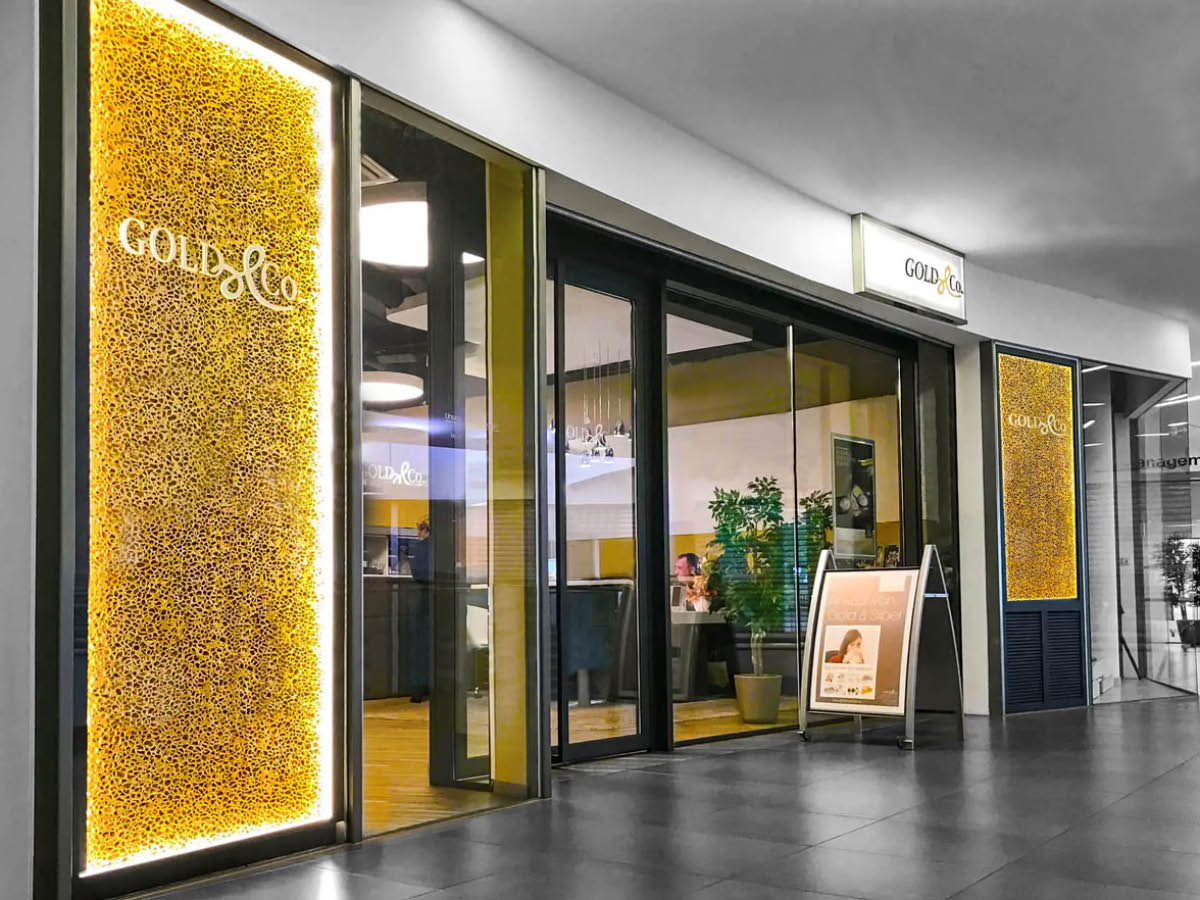
22nd district
K1 shopping centerKagraner Platz 1/1st floor
1220 Vienna
Parking - 1 hour free in underground garageOPENING HOURS
Directions on Google Maps
You are currently viewing a placeholder content from Facebook. To access the actual content, click the button below. Please note that doing so will share data with third-party providers.
More InformationYou are currently viewing a placeholder content from Instagram. To access the actual content, click the button below. Please note that doing so will share data with third-party providers.
More InformationYou are currently viewing a placeholder content from reCAPTCHA. To access the actual content, click the button below. Please note that doing so will share data with third-party providers.
More InformationYou need to load content from hCaptcha to submit the form. Please note that doing so will share data with third-party providers.
More InformationYou need to load content from reCAPTCHA to submit the form. Please note that doing so will share data with third-party providers.
More InformationYou are currently viewing a placeholder content from Turnstile. To access the actual content, click the button below. Please note that doing so will share data with third-party providers.
More InformationYou are currently viewing a placeholder content from X. To access the actual content, click the button below. Please note that doing so will share data with third-party providers.
More Information